
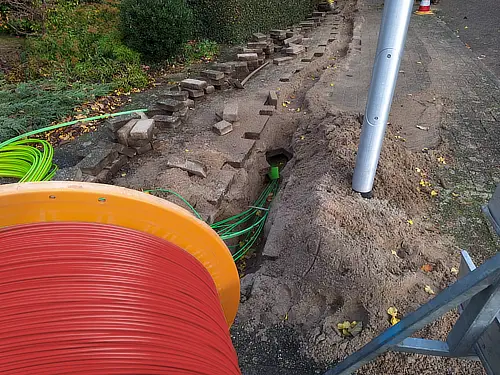
Most of that work will be done with big trenchers, plows, and tracked directional drills. But buried inside projects like this is a quieter opportunity for a different kind of tool. Short road and driveway crossings, tight right of way, and small obstacles are exactly where a compact pit launch thrust boring machine can shine.
Instead of dragging a full size HDD rig up to every 25 foot side road, contractors can use a small thrust boring setup like the PE-10 Rod Pusher from PE Equipment that runs right off the mini excavator already on site. That saves time, yard damage, and headaches for crews and property owners.
Big Fiber Miles, Small Crossing Problems
On paper, a 1,400 mile fiber build looks like one big continuous trench line. In the field, it is a patchwork. You have long stretches where a trencher or plow makes perfect sense, and then you hit the trouble spots that slow everyone down. These are the short side roads that might only be 20 to 30 feet wide, the farm or ranch driveways that cut across the route, the narrow approaches next to fence lines, and the quick crossings near existing utilities.
Those short crossings can be awkward for tracked directional drills. To get a 25 foot shot under a side road, an HDD crew often has to back a tracked rig down the right of way, tear up yards, fence lines, or landscaping just to get the machine positioned, and then deal with extra restoration that costs money and slows the job down. For a crew that already has a mini excavator on site, that feels like using the wrong tool for the job. This is where a pit launch thrust boring setup can fit nicely alongside the trencher.
Meet the PE‑10 as a Thrust Boring Helper
The PE‑10 from PE Equipment is a compact multi-function trenchless machine, in this situation the PE-10 Rod Pusher set up for pushing rods underground and pulling back small diameter pipe and conduit through short bores. It is built to work in tight pits and to be handled by small crews using the equipment they already have, like a mini excavator. Because the PE‑10 Rod Pusher is small and modular, it can be lowered into a roadside pit, lined up with the bore path, and used to push rods under a road or driveway. Once the pilot path is made, the same setup can pull back conduit or duct suitable for fiber.
The focus of the PE-10 is on sub 3 inch line work, which is exactly the range used for many fiber ducts, sleeves, and small utility conduits. Instead of relying on a large drill rig for every crossing, the PE‑10 gives crews a simple pit based option. It is light enough to move around by a couple of workers or with the excavator, and it does not need a long setback area like a conventional HDD rig. That makes it a practical choice along narrow rights of way, fence lines, and tight access spots where a bigger machine simply does not fit well.
How Pit Launch Thrust Boring Supports Fiber Builds
When building long fiber routes along roads and highways, a trencher or plow for the main run is on site, as well as a mini excavator for pits, handholes, and cleanup, and at least occasional access to an HDD rig for major crossings such as large highways or waterways. The PE‑10 Rod Pusher fits into that mix as the “small bore” tool for the frequent but short obstacles that pop up every few hundred feet.
For the 25 foot side roads, the process looks different when using a pit launch machine. You dig small entry and exit pits close to the road with the on site mini excavator and lower the PE‑10 into the entry pit, aligning it with the planned bore path. The next step is pushing rod stems under the road, and when the rods reach the far pit, attaching the conduit and pulling back through the bore, leaving a clean path ready for fiber.
Instead of moving a big drill rig for every side road, the crew keeps the main production focused on trenching. The PE‑10 gets deployed with the excavator, eliminating tracked HDD rigs driving across yards or down long approaches. This means less damage to property, fewer fence removals and temporary access issues for landowners, and lower restoration cost at each crossing. For the contractor installing fiber telecom, shorter setup, less restoration, and fewer big rig moves can add up to real savings over a long project.
Growing Fiber Infrastructure With the Right Mix of Tools
FiberLight’s investment in West Texas is just one example of a bigger trend. As AI data centers and cloud providers keep growing, more long haul and regional fiber routes will be built along highways and rural roads. Most of those miles will still be done with trenchers and HDD, because those machines are the best way to move fast over long distances and to handle major crossings.
The opportunity for a machine like the PE‑10 is in the details. Side road and driveway crossings along trenched routes, small bores near handholes, pedestals, or vaults, and short cross bores where a full HDD setup is overkill are all places where a compact thrust boring unit makes sense. When talking about the PE‑10 in this context, it’s not trying to replace HDD. It offers a way to keep the big rigs where they belong and put a lighter, easier tool on all the little crossings that slow a crew down.
A Practical Tool for Real World Fiber Work
At the end of the day, crews care about what gets them down the route faster with fewer call backs and less restoration. The PE‑10 Rod Pusher fits that mindset. Its compact size works well in tight pits and narrow right of way. It has enough thrust to handle short road bores and small conduit without the bulk and setup time of a full size drill. Because it is easy to move around with small excavators, it stays practical for everyday use, not just special jobs.
As more fiber gets built to support the AI and data center boom, the number of smaller crossings and tricky spots is only going to grow. Big headline investments like the FiberLight project show the scale of the work. Compact trenchless tools like the PE‑10 help crews handle the small but important details along the way.